


Introduction
The history of ancient Ephesus is not the story of a single civilisation frozen in time. Instead, it is a narrative of continuous transformation. Over centuries, the city evolved from a Greek trading hub into a Roman imperial capital, and later into a centre of scholarship and spiritual reflection. Each era left behind architectural, cultural, and ideological imprints that still shape how we understand Ephesus today.
When travellers explore Ephesus,s Turkey, they do far more than walk through ruins. They move through a layered timeline where spectacle, governance, philosophy, commerce, and faith once coexisted. Consequently, understanding the history of ancient Ephesus requires viewing the city not as static remains, but as a living continuum of civilisations.
The Birth of a Coastal Powerhouse
Initially, the ancient city of Ephesus emerged as an Ionian Greek settlement positioned strategically near the Aegean Sea. Because of this location, the city quickly developed into a major commercial gateway linking Asia Minor with Mediterranean trade networks.
Merchants transported spices, metals, ceramics, and textiles through its harbour. Meanwhile, travellers and pilgrims brought cultural exchange that enriched the social fabric of the city. As a result, the early history of ancient Ephesus was defined by commerce, maritime movement, and cosmopolitan diversity.
Equally important was the Temple of Artemis. Not only did it attract pilgrims, but it also elevated Ephesus into global religious prominence. Therefore, spirituality and trade evolved side by side during the city’s formative centuries.
Roman Empire Ephesus: Power Reshaped the City
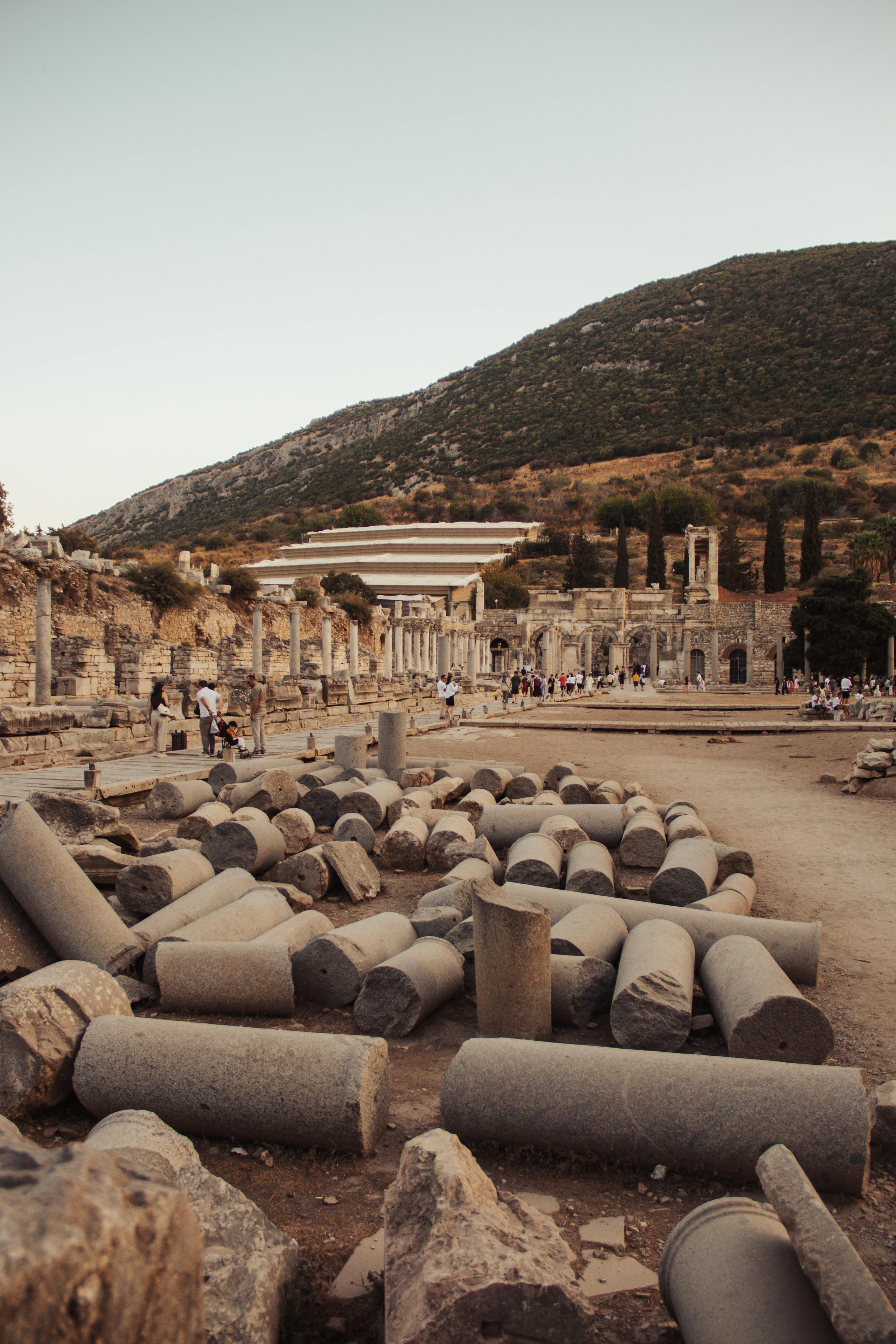
As Roman influence expanded into Asia Minor, Ephesus entered its most powerful phase. It became the capital of the Roman province of Asia — a position that transformed its political and architectural identity.
Marble streets replaced earlier pathways. Aqueducts supplied water efficiently. Public baths, fountains, and administrative complexes reflected Roman engineering mastery. Furthermore, monumental gates symbolised imperial authority.
During the Roman Empire Ephesus era, governance became highly visible. Laws were inscribed publicly. Civic announcements were delivered in open forums. Consequently, the history of ancient Ephesus expanded beyond trade into structured political dominance.
Spectacle and Power: Gladiators in Ephesus
Entertainment, however, remained central to Roman civic culture.
The Great Theatre stood as one of the largest amphitheatres in the ancient world, accommodating over 25,000 spectators. Dramatic performances took place regularly. Political assemblies gathered citizens. Additionally, gladiatorial contests energised the masses.
The presence of gladiators in Ephesus symbolised more than entertainment. These battles reinforced imperial strength and social order. Through spectacle, Rome projected dominance.
Today, during an Ephesus ruins experience, visitors stand in the same arena where crowds once roared. Consequently, the theatre remains one of the most emotionally powerful remnants of the history of ancient Ephesus.
Governance and Civic Administration
Beyond spectacle, Ephesus functioned as an administrative nerve centre.
Roman governors ruled provincial affairs from the city. Tax systems were administered locally. Trade regulations were enforced. Meanwhile, the Agora functioned both as a marketplace and a civic discussion forum.
Infrastructure planning reflected precision. Roads were aligned strategically. Drainage systems supported urban sanitation. Public buildings reinforced institutional authority.
Therefore, the history of ancient Ephesus demonstrates how governance and urban planning were deeply interconnected.
Intellectual Evolution: The Library of Celsus
As the city matured, its intellectual identity strengthened.
The Library of Celsus emerged as a monumental centre of scholarship. Built in honour of a Roman senator, it housed thousands of scrolls and manuscripts. Scholars, philosophers, and students gathered within its halls.
Importantly, the Library of Celsus’ history represents a transition from physical spectacle to intellectual prestige. Knowledge became a civic asset.
Moreover, the structure’s façade symbolised enlightenment, adorned with statues representing wisdom and virtue. Consequently, the Ephesus cultural history expanded to include academic influence alongside political authority.
Civilian Life in the Ancient City of Ephesus
While monumental architecture dominates visual memory, everyday citizens sustained the city’s vitality.
Merchants traded in the Agora. Artisans produced goods for export. Families resided in Terrace Houses decorated with mosaics. Meanwhile, bathhouses functioned as both hygiene centres and social hubs. Fountains supplied water. Streets connected neighbourhoods. Markets facilitated economic exchange.
Thus, the history of ancient Ephesus reflects not only emperors and scholars, but also ordinary lives woven into the city’s fabric.
Spiritual Transformation: Christianity Rises
Over time, religious dynamics shifted dramatically. The Apostle Paul preached in Ephesus, establishing early Christian communities. Biblical references further elevated the city’s spiritual importance. As Christianity spread, pagan temples declined in influence. Churches and basilicas emerged. Faith gatherings replaced arena spectacles.
The spiritual history of Ephesus marks this transition clearly. Consequently, the city’s identity evolved from polytheistic grandeur to monotheistic devotion.
Environmental and Economic Decline
Despite its prominence, Ephesus faced environmental challenges. Sediment gradually filled its harbour, restricting maritime access. Trade diminished. Economic momentum slowed. Additionally, earthquakes damaged infrastructure.
Because commerce declined, population levels fell. Administrative importance shifted elsewhere. Therefore, the history of ancient Ephesus entered a phase of gradual decline.
Rediscovery Through Archaeology
Centuries later, archaeological expeditions uncovered the buried city. Excavations revealed theatres, libraries, temples, and residential quarters. Restoration efforts preserved architectural brilliance while uncovering cultural narratives.
Today, guided tours of Ephesus allow visitors to witness these rediscoveries firsthand. Consequently, archaeology became a modern chapter in the history of ancient Ephesus.
Civilisations Layered in Stone
Ephesus reflects overlapping civilisations rather than a singular legacy. It was Greek in origin. Roman in power. Christian in devotion. Byzantine in adaptation. Each era layered beliefs, architecture, and governance onto existing foundations. Therefore, the civilisations of Ephesus coexist visibly within the same archaeological landscape.
The Modern Ephesus Ruins Experience
Modern travellers encounter multiple historical dimensions simultaneously. They witness Roman engineering, gladiatorial arenas, philosophical institutions, and sacred Christian landmarks within walking distance. The Ephesus ruins experience is immersive precisely because it is chronological. Each monument reveals a different phase of the history of ancient Ephesus.
Why the History of Ancient Ephesus Still Matters
The city’s enduring relevance lies in its adaptability. It entertained crowds. It educated scholars. It guided believers. It governed provinces. Moreover, it demonstrates how civilisations evolve rather than remain fixed. Consequently, the history of ancient Ephesus serves as a mirror reflecting humanity’s shifting priorities across centuries.
Understanding Ephesus Beyond the Surface
At Ephesus Bus Tours, we believe meaningful exploration begins with understanding. Visiting Ephesus is not simply about walking through impressive ruins — it is about grasping the depth of the civilisations that shaped them. The history of ancient Ephesus unfolds through layers of political power, intellectual growth, and spiritual transformation, each era leaving a lasting imprint on the city’s identity. Through thoughtful interpretation and a historically grounded perspective — the kind thoughtfully woven into every experience with Ephesus Bus Tours — what may appear as marble remains becomes a living narrative of ambition, belief, and evolution. When history is experienced with context, it becomes more than visible — it becomes powerful.
Final Reflection
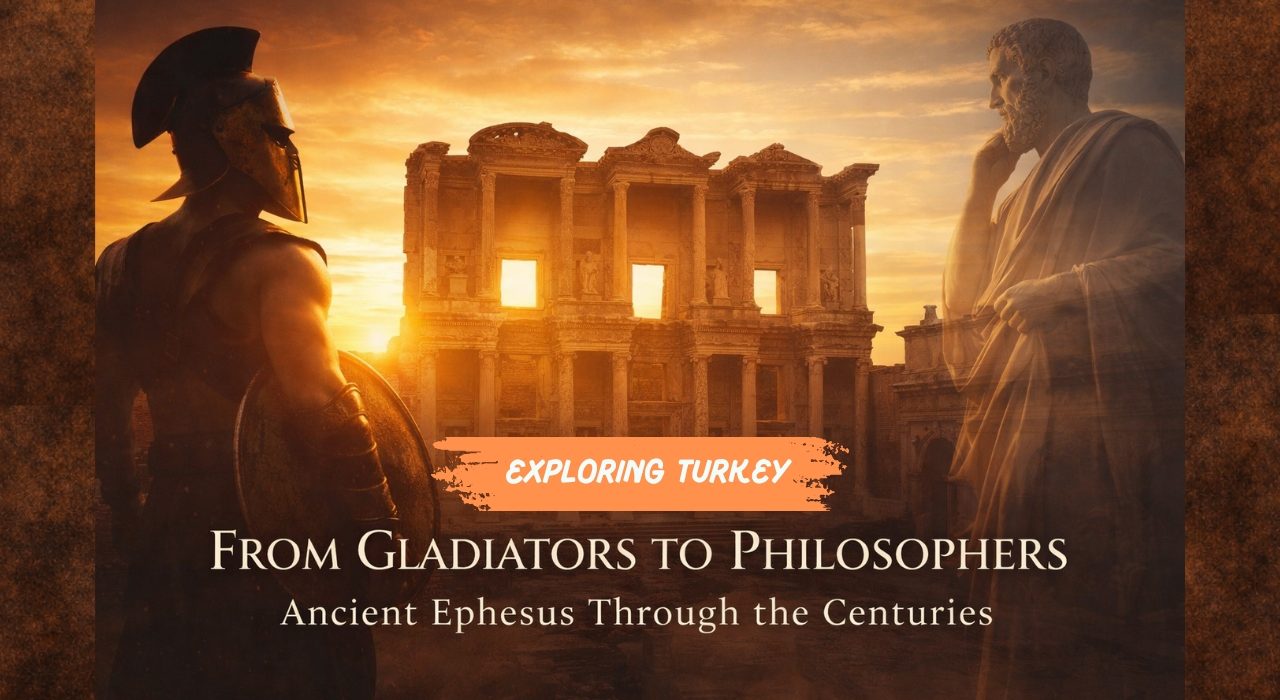
From gladiators to philosophers, from imperial administration to spiritual pilgrimage, Ephesus lived many lives. Its transformation is what makes it timeless. When visitors explore Ephesus, Turkey today, they walk through layered civilisations rather than isolated ruins. Ultimately, the history of ancient Ephesus stands as a testament to human ambition, intellect, faith, and resilience.